How to Develop a Powdered Beverage: From Product Brief to Production
Written by: EDMARK Industries SDN BHD
8 min read
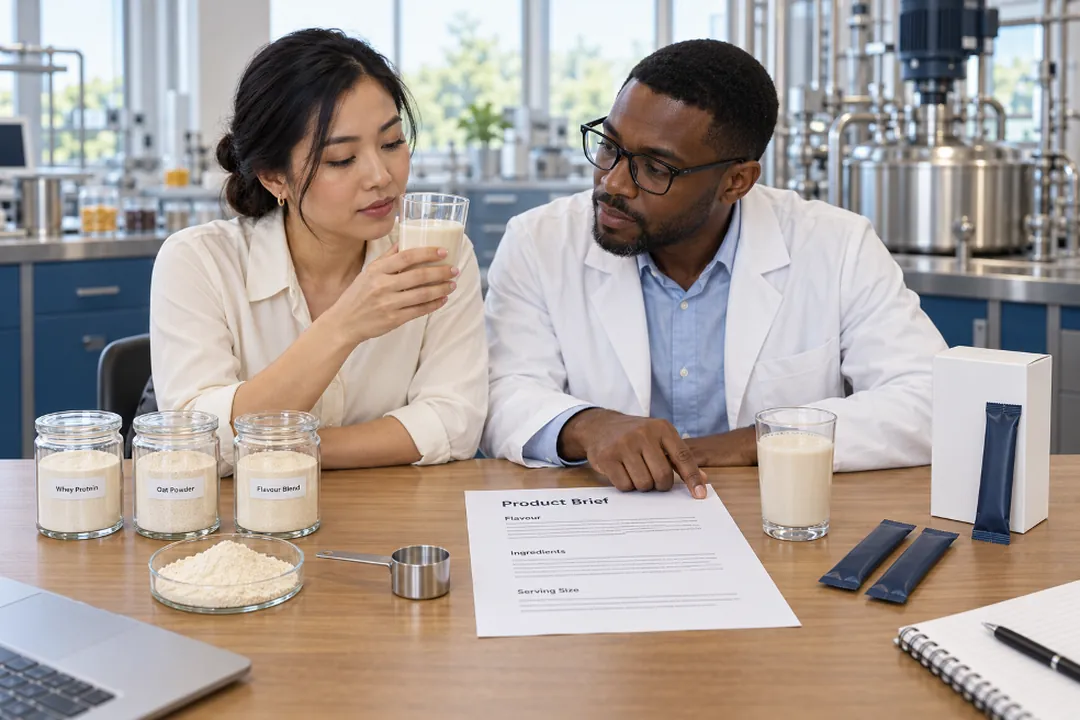
A useful brief describes the customer, serving size and preparation method before recipe trials begin.
Powdered beverage development starts with a clear description of the drink your customer wants to make. Beverage formulation turns that description into a recipe. Before production, you also need to check how the drink mixes, choose packaging and confirm that the factory can make it consistently.
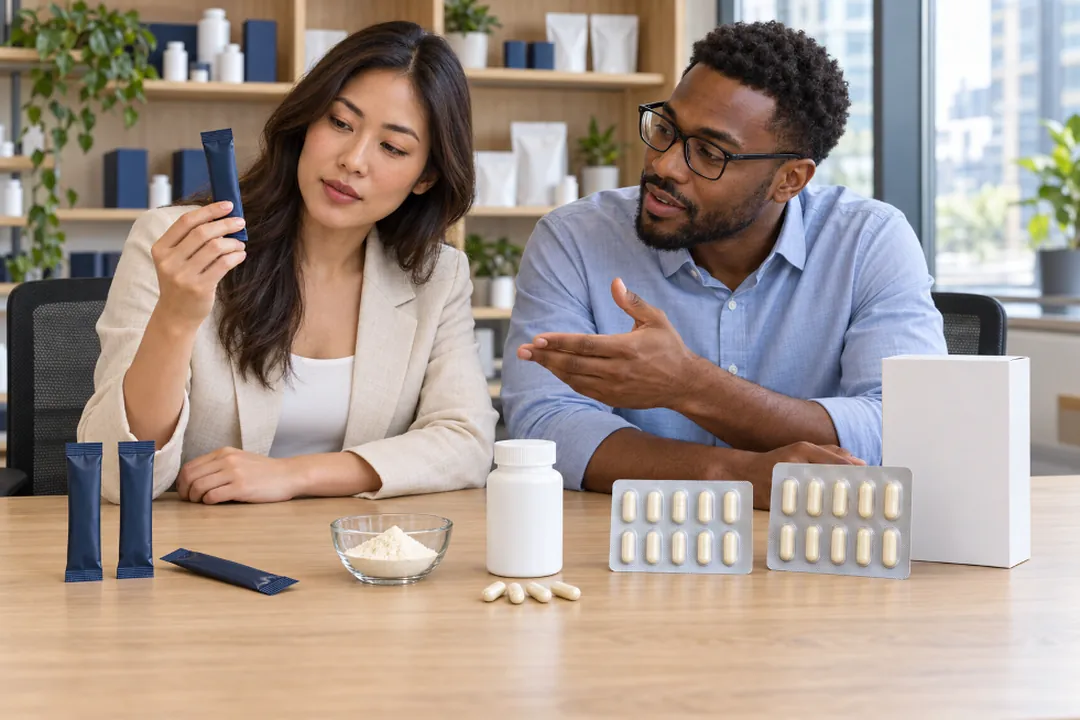
You can approach a manufacturer without a finished formula. Explain who the drink is for, how people will prepare it and what it should cost. If an existing recipe suits your customer, selling it under your own brand, known as private label, may be enough for an early market test. For a custom product, explain what needs to be different.
A good-tasting sample is one approval along the way. It does not settle the packaging, shelf life or production checks.
Key Summary
Describe the drinking experience and separate essential requirements from preferences you can change.
Test samples using the water, temperature and mixing method intended for customers.
Record the sample version and specific changes you want.
Compare quotations using the same serving size and complete pack requirements.
Check shelf life with the intended recipe and packaging.
Separate approval of the recipe from approval to start production.
1. What Should Your Product Brief Include?
Your product brief should describe the finished drink and the conditions it must work under. It is the starting document you share with the development team.
“A healthy chocolate drink” leaves many decisions open. A drink made with cold water at work is a different assignment from one made with hot milk at home.
What to Decide
What to Put in the Brief
Why It Helps
Customer and occasion
Who drinks it, where and when
Gives the team a specific use to develop for
Selling market
Countries and sales channels
Allows early checks of ingredients, claims and labels
Preparation
Powder amount, liquid, water temperature and spoon or shaker
Defines the conditions samples must meet
Taste and texture
Flavour, sweetness, thickness and any reference product
Gives meaning to words such as “creamy” or “light”
Ingredient requirements
Ingredients wanted or excluded, allergy concerns and dietary requirements
Identifies restrictions before recipe trials
Packaging and storage
Single-serving sachet or larger pack; likely transport and storage conditions
Brings packing and shelf-life questions into development
Commercial limits
Target selling price, manufacturing budget and expected first order
Helps the team assess a financially workable recipe
Mark each requirement as essential or flexible. If cold-water preparation is essential but the flavour can change, say so. Without clear priorities, the team may spend time improving something you were willing to change.
Explain what you like about a reference product: “We like its cocoa flavour, but want a lighter texture.” That gives the team a useful comparison without asking it to reproduce another brand exactly.
2. What Should You Check Before Formulation Starts?
Check which rules apply to the product and what you may say on its packaging in each country where you plan to sell it.
In Malaysia, a powder mixed into a drink is not automatically a registered health supplement. The National Pharmaceutical Regulatory Agency’s guidance places certain instant drinks under food rules. It also explains how to assess products that fall between food and medicine. The ingredients, claims and way the product is presented matter. If you are unsure which rules apply, ask the manufacturer to help you obtain classification advice. 1
Keep taste instructions separate from proposed pack claims. In your development brief, “less sweet” describes a taste preference. Calling the drink “low sugar” on its packaging requires it to meet the relevant rules; tasting the drink cannot establish that. Malaysia’s Food Regulations set conditions for nutrition labels and claims. Have proposed pack wording reviewed before artwork is printed. 2
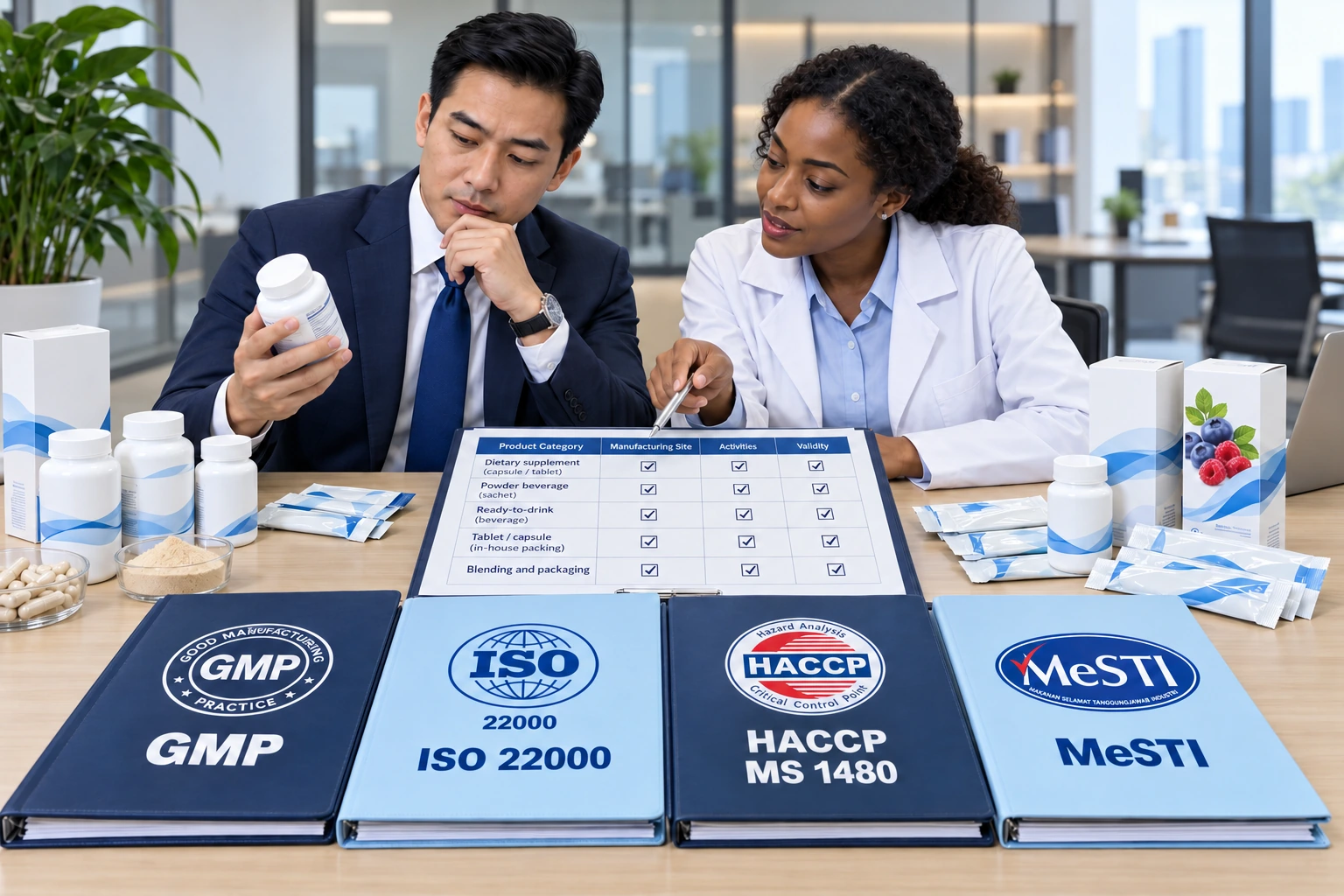
For export projects, ask who will check the destination market’s requirements. Treat Halal coverage as a separate check too: the guide for brand owners explains what to verify for your branded product.
3. What Happens During Powdered Drink Formulation?
During beverage formulation, the development team selects ingredients and tests different amounts against your brief. Your role is to assess whether each sample suits your customer and meets the requirements you agreed.
Ask the team to explain each proposed change in ordinary language. If an ingredient changes, what happens to flavour, thickness, mixing and cost?
Sugar dissolves into water. Other ingredients may mix through the drink without fully dissolving, and some may settle at the bottom. Ask whether settling is expected for your recipe and agree what your customer would find acceptable. A little settling and unpleasant dry lumps are different things to assess. 34
Describe the experience you want: no unpleasant dry lumps, an acceptable texture and preparation instructions customers can follow. Let the technical team propose how to achieve it.
Check the cost against a complete retail pack. Ask whether a quote includes filling, sachets, the outer box, agreed testing and any separate development charges. The MOQ guide explains how minimum order quantity affects the commitment.
Compare costs per serving too. A smaller serving may make a quote look cheaper while giving the customer a different drink. Use the same serving size and pack requirements when comparing proposals.
4. How Do You Give Useful Sample Feedback?
Prepare the drink as your customer will. If the pack will say “stir into cold water,” use cold water and a spoon. Seeing it mix well in a blender does not tell you whether a spoon will work.
Keep the powder amount, water volume, temperature and mixing time consistent when comparing recipes. Test preparation variations separately. Changing both the recipe and the amount of water makes it harder to understand why one cup tastes different.
Keep a short record of each trial:
Identify the sample code, version and date you tested it.
Record the powder weight, liquid volume, temperature, equipment and mixing time.
Describe the sweetness, flavour, aftertaste, thickness, lumps, foam and settling.
Say what to keep, what to change and which change matters most.
“Too sweet, but keep the cocoa strength and thickness” gives the team a clearer task than “make it better.”
Keep the powder amount, water volume and mixing method the same when comparing recipes.
Include people who resemble your intended customers. Ask whether they enjoy the drink, find it easy to prepare and would consider buying it at your intended price. Feedback from a small group can guide development, but it does not prove future sales. 5
Decision Exercise: Which Cocoa Sample Should Move Forward?
This example uses hypothetical quantities, results and criteria to show how to compare samples. It is not an EDMARK Industries SDN BHD customer case or a standard testing method.
Suppose your brief calls for a 25 g sachet mixed into 200 mL of room-temperature water with a spoon. You agree to compare samples after 30 seconds of stirring. “No visible dry lumps after stirring” is an essential requirement.
Trial
Preparation
Observation
Decision
Sample A
25 g in 200 mL; spoon; 30 seconds
Preferred flavour, but dry lumps remain
Request a mixing improvement while retaining the flavour
Sample B
Same method
No dry lumps; drink tastes too sweet
Request lower sweetness while retaining mixing performance
Sample A, repeated differently
25 g in 250 mL; shaker
Fewer lumps and a thinner drink
Keep as a separate experiment; it does not meet the original brief
The last trial used 25% more water: 250 mL instead of 200 mL. It also changed the mixing equipment. Those results do not show whether the recipe itself improved.
For this brief, Sample B is the better starting point for the next trial because it meets the essential preparation requirement. Retest both sweetness and mixing after the recipe changes. Neither sample is approved for production. If customer testing later supports a drink prepared in a shaker, update the brief and test against that new requirement.
5. How Do Packaging and Shelf-Life Checks Fit In?
Agree on the pack and storage needs in your product brief. Then assess the selected recipe in the pack you intend to sell. Shelf life describes how long a product stays safe and within its agreed quality limits under stated storage conditions.
Packaging affects exposure to moisture, gases and light. Food Standards Scotland’s shelf-life guidance explains why packaging and storage conditions matter. Use it as technical background, not Malaysian law. 6
Ask the team what could shorten your drink’s shelf life and how they will check it. Tests may cover flavour changes, clumping, how well it mixes, food safety and any nutrition values claimed on the label. Agree what the product must pass and what evidence you will receive.
For a larger pack opened repeatedly, ask how long customers can keep it after opening and what evidence supports that advice. A sealed sachet and an opened tub are used differently. 12
Dry powder still needs food-safety controls. Research published by the US Food and Drug Administration shows that harmful bacteria such as Salmonella can survive in dry foods. Ask how the manufacturer checks ingredients and prevents contamination during production. Taste cannot tell you whether those safety checks have passed. 7
6. What Must Be Agreed Before Production?
Agree what the factory must deliver and how it will show that the product meets your requirements. Put those details in a specification, the written description of an acceptable product.
Making a bigger batch involves more than multiplying the recipe. Powders can separate as they move through equipment, so the team needs to check that ingredients stay evenly mixed. Tetra Pak’s powder-mixing guidance explains why this matters during mixing and handling. 8
A pilot trial is a smaller production trial used to check the recipe and process before a larger run. Ask which equipment it will use, how closely it represents the intended production process and what results must pass. Tetra Pak describes these trials as a way to test recipes and processes before full production. 9
Before authorising production, record:
The approved formula version, preparation instructions and reference sample.
The written product requirements, including agreed taste, mixing and test results.
The packaging details, powder weight per pack, seal checks and final artwork version.
The shelf-life evidence and storage instructions agreed for the product.
Regulatory responsibilities, required documents and who may release each batch, or production run, for sale.
The final quotation, quantity, schedule and approval responsibilities.
Give any unfinished work an owner and due date. Confirm which checks must pass before production starts and which must pass before the product can be sold. Complete the required checks before signing the relevant approval.
Also agree who owns the formula, what documents you receive and how ingredient substitutions or later changes will be approved. Settle these questions when agreeing the development fee.
Use separate written decisions for “recipe accepted” and “production authorised.” If the recipe or packaging changes afterward, ask which checks must be repeated. Shelf-life evidence may need review when a product or pack changes. 6
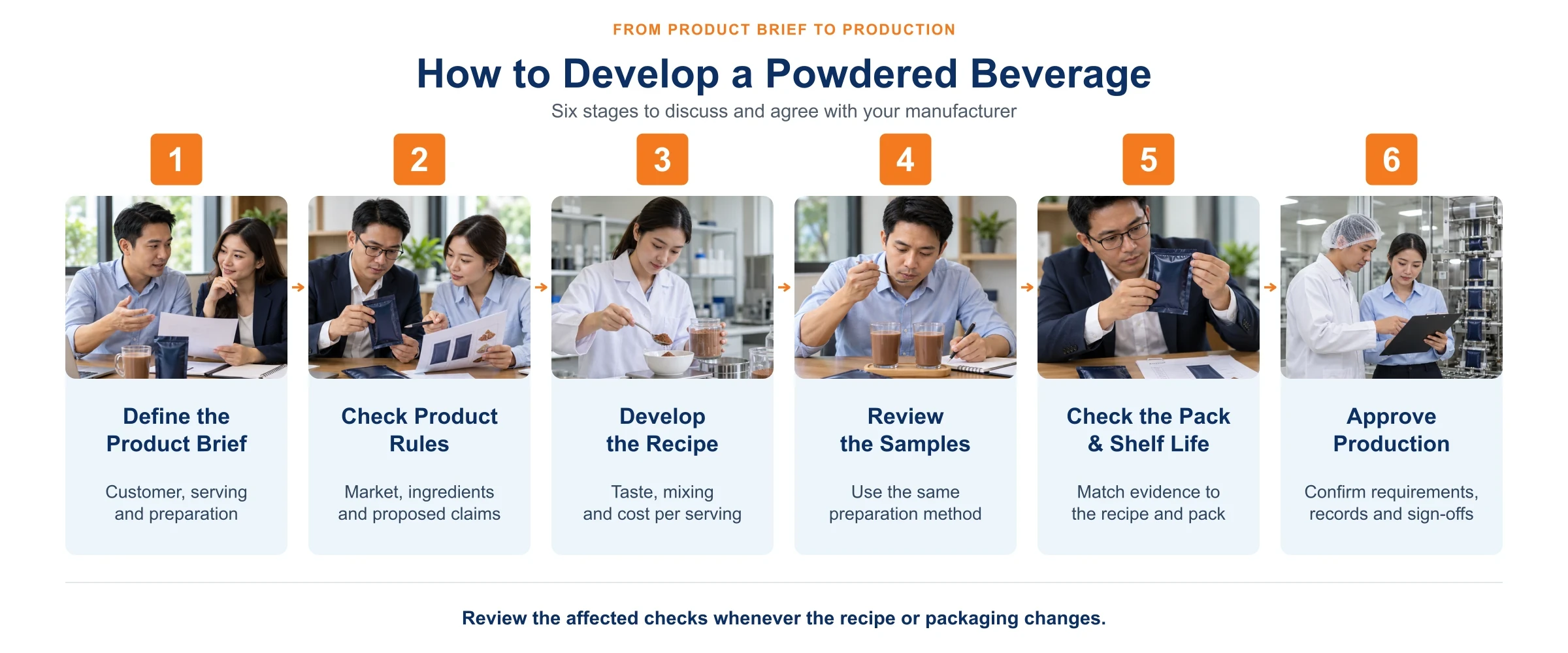
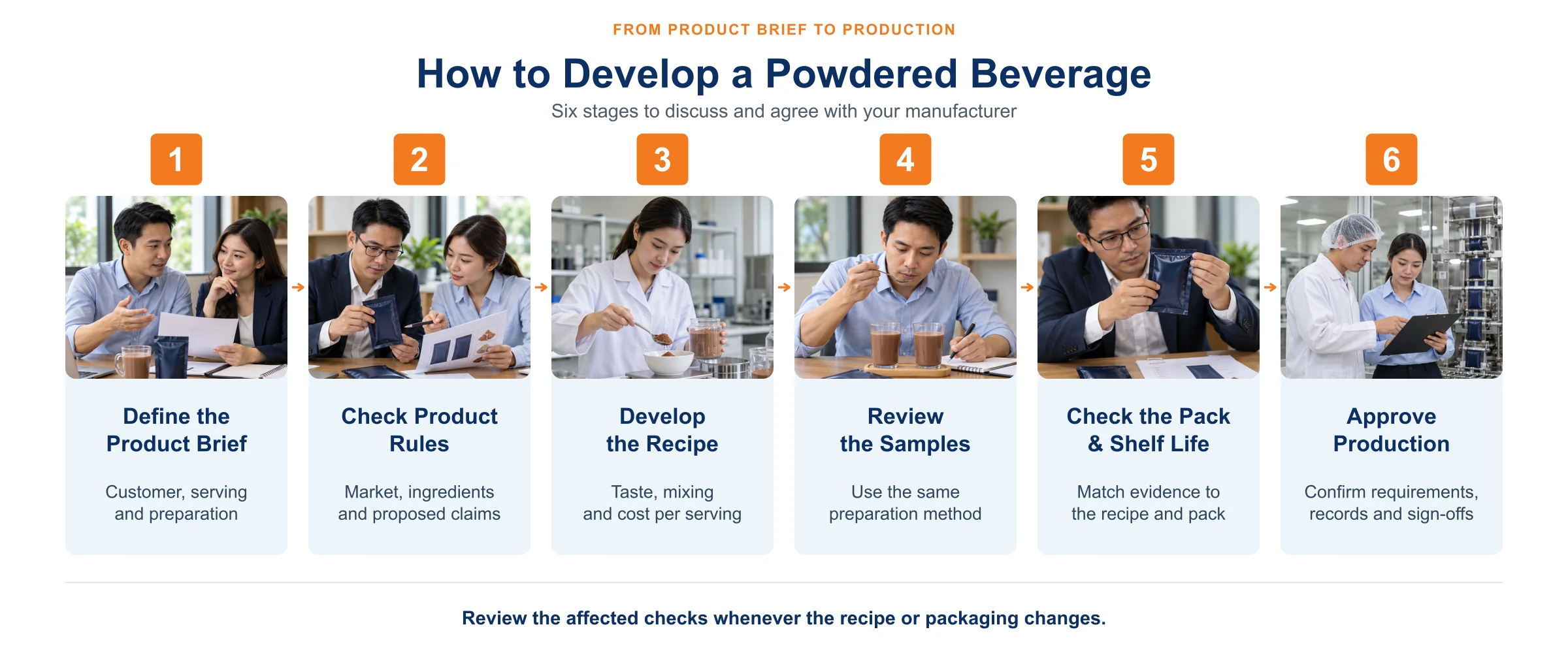
Follow the six development stages, and review affected checks whenever the recipe or packaging changes. View the process at full size.
Frequently Asked Questions
Do I Need a Formula Before Approaching a Manufacturer?
No. A brief can start the discussion. Explain your customer, market, preparation method, taste preferences and budget. If you bring an existing formula, confirm that you have the right to use and share it.
How Long Does Powdered Beverage Development Take?
Ask for a schedule based on your project’s stages. Recipe changes, ingredient supply, packaging trials, testing and market requirements can all affect timing. Confirm what must be approved before each stage begins. Do not treat the sample-delivery date as your launch date.
What Should I Confirm Before Paying for Development?
Ask what the fee covers: sample revisions, ingredient sourcing, testing and documents. Agree how extra revisions will be charged, who owns the formula and what you receive if development stops. Get those terms in writing before paying.
Can I Change the Packaging After Approving the Sample?
Discuss the change before ordering packaging. A different material, seal or pack format may affect shelf life and require further checks. Ask what needs to be repeated, what it will cost and how it affects the schedule. 6
What Should You Send the Manufacturer?
Use the brief table above to write one page about your proposed drink. Mark any details you have not decided yet and ask the manufacturer to address them in its response.
Prepared 24 October 2026; reviewed 29 October 2026. The worked example is illustrative. Product-specific tests, limits and approvals must be agreed for the intended recipe, packaging and market.
Let’s build your next product
Still Have Questions?
From formulation to manufacturing and scale-up, our team is ready to help bring your product to market.
A manufacturer can apply on your behalf, but its OEM certificate alone does not cover your branded product. Check coverage before printing the Halal logo.