GMP, ISO 22000, HACCP MS 1480 & MeSTI: What Each Covers for OEM Brand Owners
Written by: Yee Ming
10 min read
Check what each framework covers before comparing manufacturers.
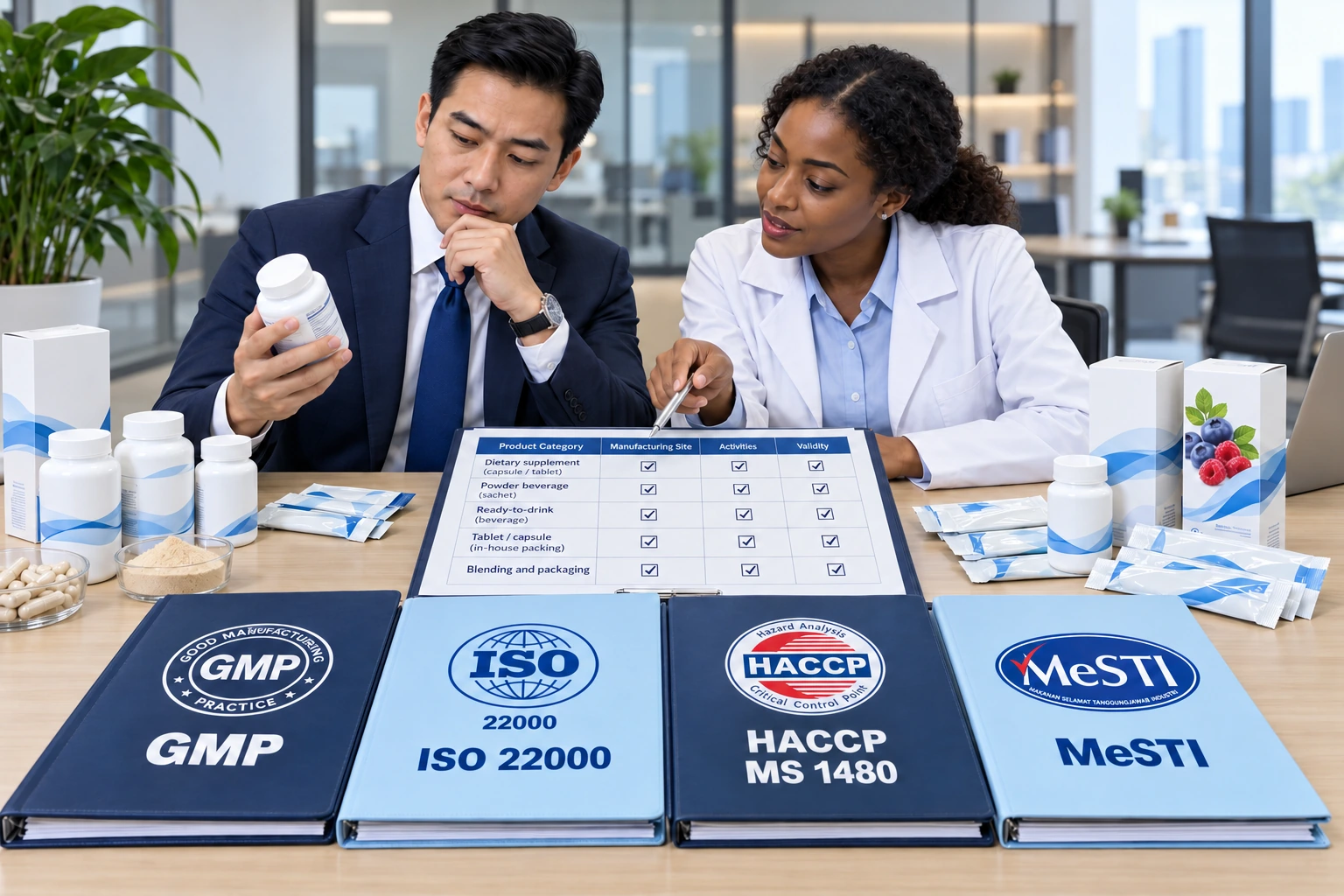
Two OEM manufacturers may offer similar product samples but present different certificate lists. To compare them, you need to know what GMP, ISO 22000, HACCP MS 1480 and MeSTI cover, and which evidence your launch needs.
A valid certificate can still cover a different product category or factory. Before comparing quotations, ask: Does this evidence cover my product and the activities at the factory that will make it? Then check the requirements of your sales market and buyer.
Core insight
A longer certificate list does not make an OEM a better fit. Look for current, verifiable evidence that applies to the work your project needs.
What this guide covers
Separate GMP, HACCP MS 1480, ISO 22000 and MeSTI by the purpose each serves.
Compare Malaysian authority schemes with international third-party certification, including their strengths and limits.
Put the credentials listed on Edmark’s compliance page into the correct categories.
Decide which evidence matters for your product classification, sales channel and target country.
Check certificate scope, status and issuer before choosing a manufacturer or committing to an order.
What does each term mean?
Term
What it covers
What a brand owner should confirm
GMP: Good Manufacturing Practice
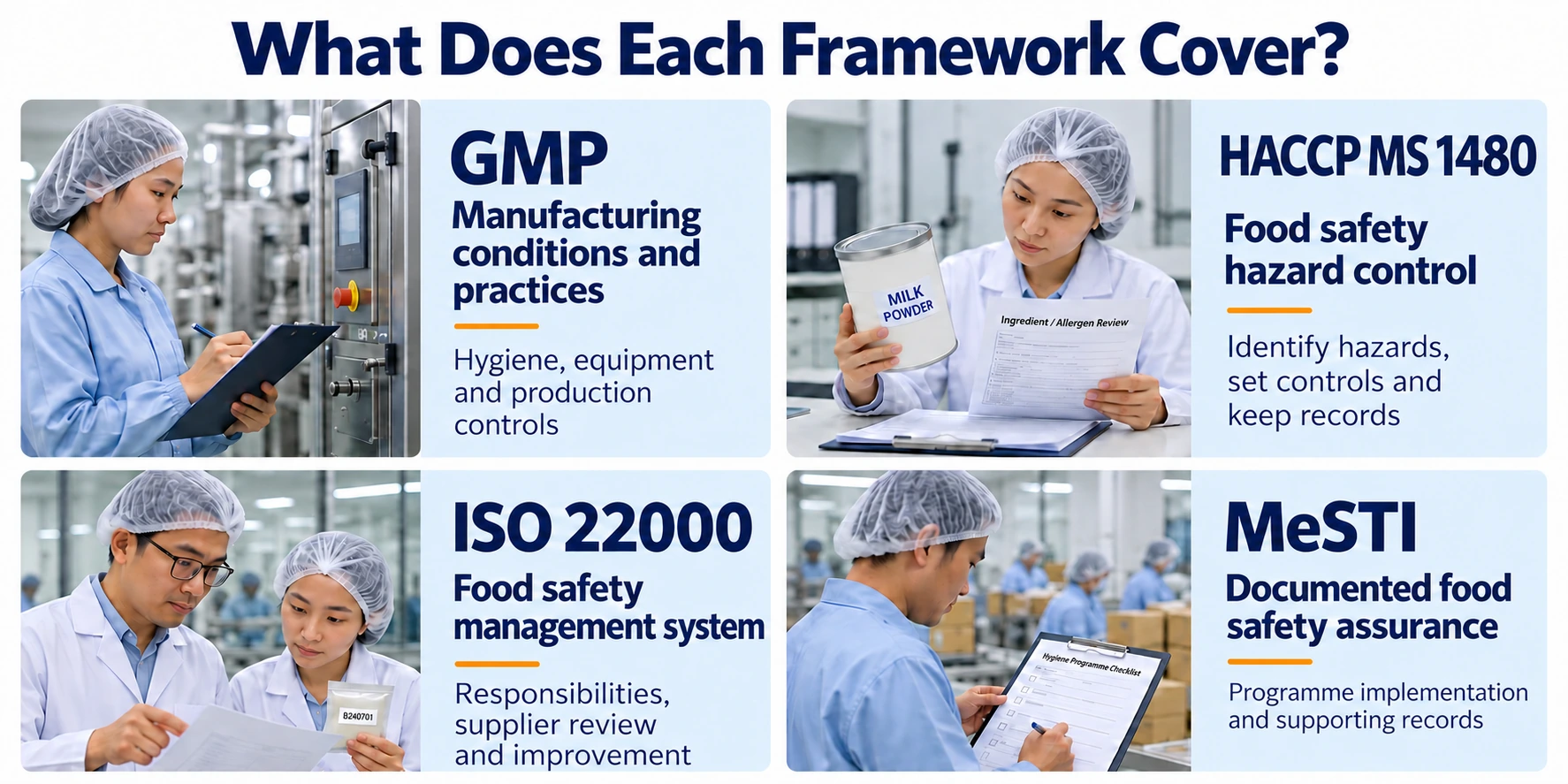
Manufacturing conditions and practices under a defined standard or regulatory scheme
Which GMP requirements apply, who assessed them, and which activities and product categories are covered
HACCP: Hazard Analysis and Critical Control Points
Identification and control of significant food safety hazards
Whether the relevant products and processes fall within the certified scope
MS 1480
The Malaysian standard for a HACCP system
The edition used and any applicable transition arrangements
ISO 22000
A food safety management system combining hazard control with management responsibilities and communication
The certified site, activities, product scope and certification body
MeSTI: Makanan Selamat Tanggungjawab Industri
A Malaysian scheme supporting implementation of a food safety assurance programme
Whether its scope and the manufacturer’s controls meet the needs of the product and intended buyer
HACCP and MS 1480 belong together in this discussion: HACCP is the approach, while MS 1480 sets Malaysian system requirements. Definitions are drawn from MOH’s certification guidance, ISO and MOH’s MeSTI guidance.
A certificate’s scope is its stated coverage, including the site, product types and manufacturing activities. For example, if a quotation names Site B but the certificate lists only Site A, ask for evidence covering Site B before treating the certificate as relevant to your order.
Local or international compliance: which matters more?
Both can matter. Start with the requirements for your product and sales market, then establish any additional certification your buyer specifies.
In Malaysia, the relevant bodies may include Kementerian Kesihatan Malaysia (KKM), called the Ministry of Health (MOH) in English, the National Pharmaceutical Regulatory Agency (NPRA), and JAKIM for Halal certification.
ISO publishes ISO 22000. Certification bodies such as SGS audit and certify organisations against it; they do not replace a regulator. ISO: certification, SGS Malaysia: ISO 22000.
Route
Advantages for a brand owner
Limits to understand
Malaysian authority schemes, such as MOH food GMP, HACCP MS 1480 and MeSTI
Evidence connected to Malaysia’s food safety framework, with MOH verification routes.
Coverage is specific to the stated site, products and activities. Another country or retailer may have additional requirements.
NPRA oversight and category-specific GMP for health supplements, traditional products and cosmetics
Evidence suited to product categories overseen by NPRA.
Factory GMP status does not complete product registration, notification, claims or documentation requirements.
JAKIM Halal certification
Evidence against Malaysia’s Halal certification requirements where Halal is part of the launch brief.
Halal coverage needs its own review. It does not replace food safety or product-market requirements.
ISO 22000 certification from an independent body such as SGS
Third-party evidence of a food safety management system against an internationally used standard.
It is not government product approval or permission to sell everywhere. Confirm whether the buyer accepts the particular scheme.
Keep legal requirements and buyer specifications separate in your brief. A factory may meet Malaysian requirements yet lack a certificate your distributor requires. For a launch in Malaysia, the US or China, check the destination’s regulatory requirements separately.
What does GMP cover?
GMP addresses the conditions and practices used to manufacture products. In food production, these include hygiene, sanitation, equipment and production controls. Malaysia’s Ministry of Health operates a food GMP certification scheme based on MS 1514. MOH: GMP.
The applicable GMP requirements depend on the product category. A food GMP certificate alone does not establish that a factory meets the requirements for manufacturing your skincare product.
For Malaysian health supplements, NPRA’s registration guidance identifies the relevant GMP evidence for local and foreign manufacturers. Cosmetic products must follow cosmetic GMP or its equivalent, with separate requirements for notification and product documentation. NPRA: health supplement preparation, NPRA: cosmetic requirements.
Ask which GMP requirements apply to your proposed product and which manufacturing activities were assessed. If a different company will carry out packing, include that arrangement in the review. “We have GMP” needs that context before you can compare suppliers.
What does HACCP MS 1480 cover?
HACCP examines how food safety hazards could arise and how the operation will control them. It addresses biological, chemical and physical hazards through hazard analysis, critical control points, limits, monitoring, corrective action, verification and records. FDA: HACCP principles and application guidelines.
Consider a hypothetical powdered beverage containing milk ingredients. Ask how the team identifies those ingredients, prevents allergen cross-contact and checks that the correct packaging label is used. Cross-contact means an allergen unintentionally enters another product. The answers should relate to your proposed formulation and production line.
Malaysia’s MOH HACCP scheme requires HACCP and prerequisite programmes, including GMP. Prerequisite programmes are routine conditions and practices, such as cleaning and hygiene, that support food safety. The hazard analysis determines which steps are critical control points. MOH also provides for adding new products to a certified scope, so ask whether your proposed product needs an extension. MOH: HACCP certification.
MS 1480:2025 replaces MS 1480:2019, with MOH specifying a transition period from 24 October 2025 to 24 October 2027. During this period, an older edition on a certificate is a reason to ask about the transition plan, rather than sufficient evidence to declare the certificate invalid. MOH: MS 1480 transition notice.
What does ISO 22000 add?
ISO 22000 places food safety controls within a management system, combining HACCP principles with prerequisite programmes, communication and management responsibilities. Certification evaluates that system within its stated scope. ISO: ISO 22000:2018.
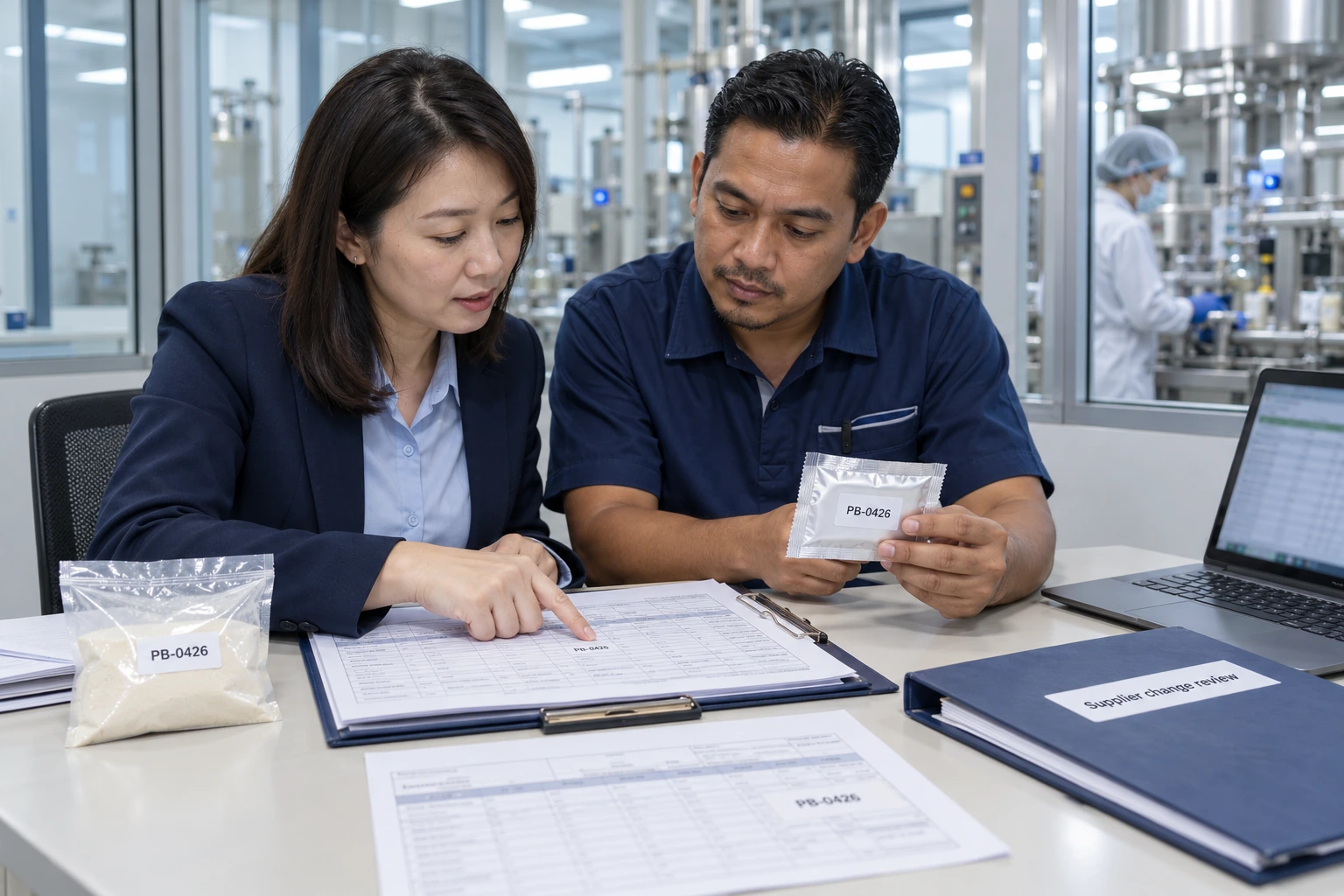
This matters when suppliers or processes change. If an ingredient source changes, ask who reviews the change, how affected batches can be traced and how your brand will be informed. If a process deviates from its agreed conditions, ask who decides what happens to the batch and records the follow-up. These questions help you assess how the system works between audits.
ISO 22000 does not, by itself, prove a product’s advertised benefits or grant permission to sell it in every country. It also does not establish acceptance by a retailer that specifies a different scheme. Check the actual procurement requirement before signing a manufacturing agreement.
Where does MeSTI fit?
MeSTI helps Malaysian food manufacturers establish a documented food safety assurance programme. MOH introduced the scheme to make baseline compliance more accessible, particularly for smaller businesses.
Malaysia’s Food Hygiene Regulations 2009 require food manufacturing premises to maintain a food safety assurance programme. MeSTI is one route; MOH also identifies GMP, HACCP and ISO 22000 programmes. A manufacturer does not need to collect every certificate to meet that requirement. MOH: MeSTI.
A manufacturer with MeSTI may be suitable where its controls and documentation meet the product and buyer requirements. If your customer specifies a different certification, obtain that requirement in writing before shortlisting factories. MeSTI should be assessed against the brief rather than dismissed because another supplier lists more certificates.
Edmark’s compliance page lists several types of evidence. They are not all the same kind of credential.
Listed item
How it should be described
GMP Codex Alimentarius; Food GMP; Health Supplement GMP; Traditional GMP; Cosmetic GMP
GMP credentials and references for specific product categories. Use the wording and scope shown on the applicable certificate.
ISO 22000:2018
Food safety management system certification from SGS, subject to the scope on the certificate.
HACCP MS 1480
HACCP certification from Malaysia’s Ministry of Health, subject to the products and activities in scope.
Halal JAKIM
Halal certification. Check that the product, ingredients, processes and premises fall within the applicable scope.
MeSTI
A Ministry of Health food safety assurance scheme.
USFDA and MoCRA
Facility registrations with the US Food and Drug Administration (FDA). MoCRA is the Modernization of Cosmetics Regulation Act of 2022, the law behind the listed cosmetic facility registration. It is not a certification standard. Registration does not mean FDA approval. FDA: MoCRA, FDA: registration and approval.
GACC
A facility registration that Edmark’s page states covers powdered beverage exports to China. Confirm the current product and facility scope for the proposed export.
Federation of Malaysian Manufacturers
Membership, rather than a manufacturing certification.
Use this list to identify which documents to request. A public compliance page does not establish the current scope or status of the original documents.
Which evidence does your product need?
Start with classification. In Malaysia, calling a product a “health drink” or “supplement” does not settle whether it falls under food regulation or NPRA’s oversight. NPRA offers classification guidance and a service for uncertain cases. NPRA: product classification.
For cosmetics, check cosmetic GMP, notification responsibilities and access to the Product Information File (PIF), which holds the supporting product documentation. Food safety certification does not replace those requirements. NPRA: cosmetic requirements. For home-care products, establish the requirements for the intended use and claims separately.
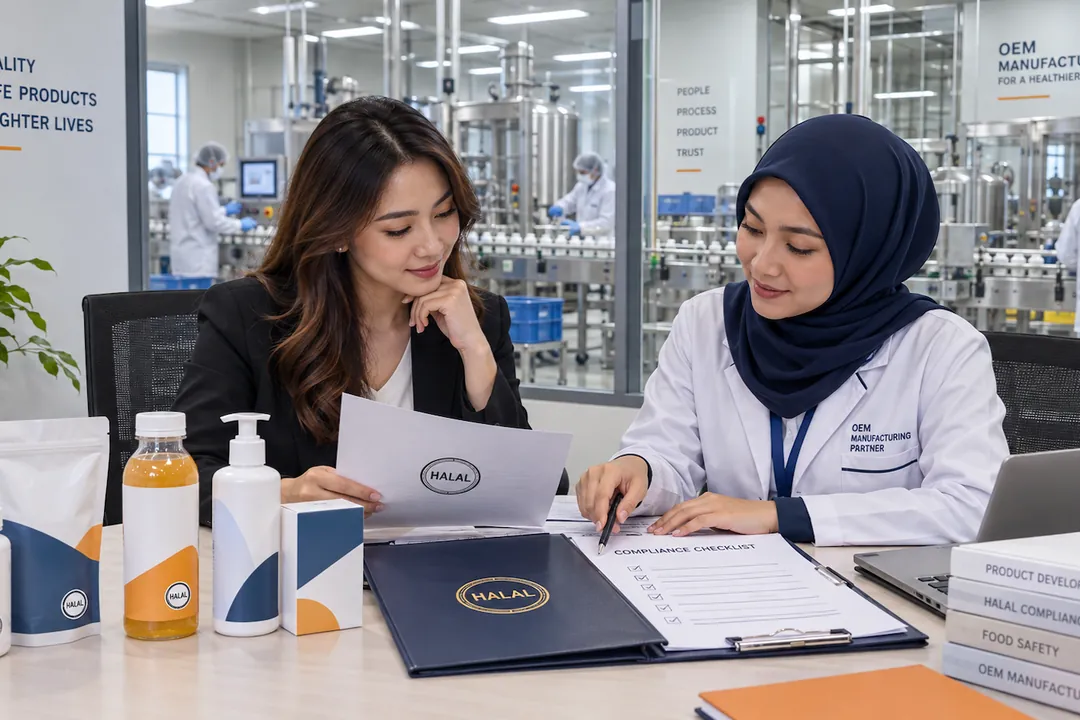
Resolve uncertain classification before asking factories to quote against a certification requirement. Review Halal coverage separately where it forms part of the brief. Our guide Do You Need Your Own JAKIM Halal Certification? explains how to check coverage for your branded product.
Give shortlisted suppliers the same product specification, testing, documentation and packaging requirements so their quotations cover comparable work. Edmark’s guide to minimum order quantity explains how format and packaging affect the production commitment.
How should you check a manufacturer’s certificates?
Request complete documents, including any schedules or annexes. These are accompanying pages that may specify the covered sites, products or activities; the certificate’s front page may not give the full picture. Then check:
The legal company name and manufacturing address. Confirm where your actual production will take place.
The standard, edition and issuer: the authority or certification body named on the document. Distinguish a certificate from a statement of compliance or registration document.
The scope. Match the products and activities to your project, including any outsourced manufacturing or packing. Ask who will perform each activity if several sites or companies are involved.
The current status. Check validity dates and verify with the issuing body or relevant official directory.
Changes affecting the project. Ask whether a new product, line or site needs further assessment before production.
You can use this document request:
Please send the current certificate and complete scope or annex for our proposed product, including the manufacturing address and covered activities. Confirm where manufacturing and packing will take place, how we can verify the certificate with its issuer, and whether any extension or assessment is needed before production.
MOH directs buyers to FoSIM’s public access facility to check holders of GMP, HACCP and MeSTI certificates. Use the directory alongside the documents, and resolve any mismatch with the issuer. MOH: GMP verification guidance, MOH: MeSTI verification guidance.
Follow the certificate review with operational questions. Request the agreed finished-product specification, an example certificate of analysis (COA), and an explanation of how the factory approves a batch for shipment. Confirm who handles traceability and recalls.
A factory certificate describes an assessed system or set of practices; a COA reports test results for a particular batch. Ask how those results are checked against the agreed specification before a batch is released.
Batch records and product samples support the operational review that follows certificate checks.
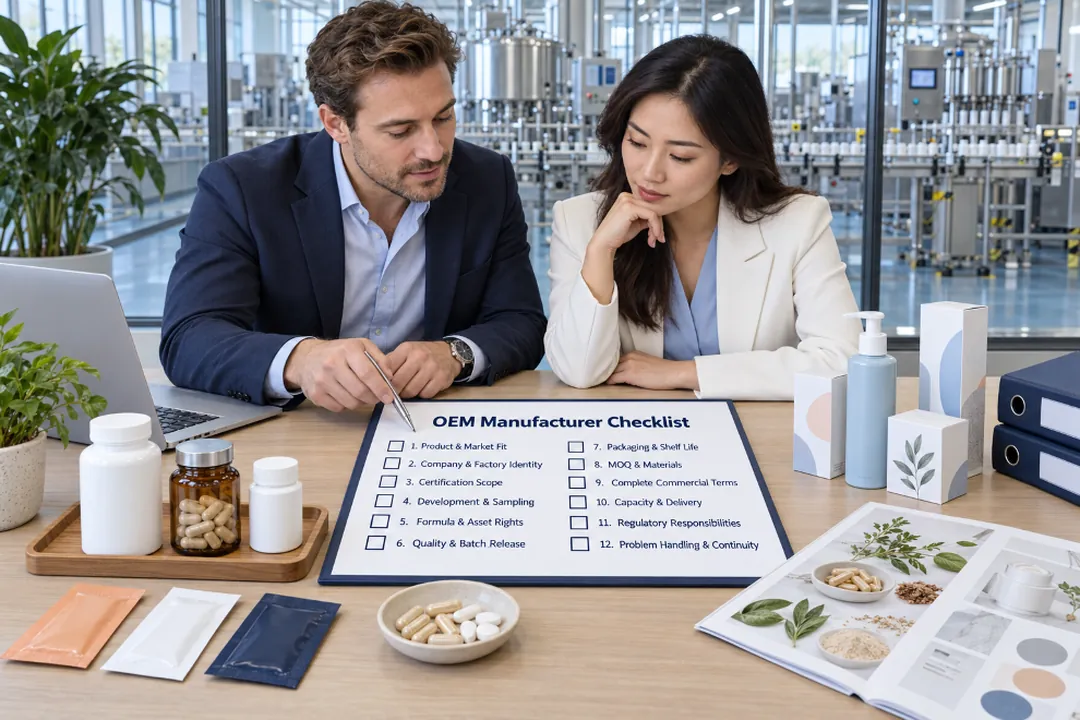
If you are replacing an unreliable manufacturer, ask for evidence addressing the reason for the move. Certification documents cannot establish available capacity, delivery performance or whether the next batch will match your approved sample. Our 12-point contract manufacturer checklist covers those operational checks alongside certification.
How would this change a supplier decision?
Consider this hypothetical exercise, not an Edmark customer case.
A brand plans to launch a powdered beverage through a distributor that explicitly requires HACCP certification covering the proposed manufacture. Both shortlisted suppliers can produce an acceptable sample.
Evidence
Supplier A
Supplier B
Production proposal
Acceptable format and sample
Acceptable format and sample
Certification evidence
MeSTI; HACCP application planned
Current HACCP evidence covering the proposed site and activity
Distributor requirement
Not yet met
Met, subject to document verification and buyer acceptance
Supplier B is the stronger choice for this brief, assuming the remaining technical and commercial checks are satisfactory. A planned application gives Supplier A no confirmed certification outcome or date.
Revisit the decision if the distributor changes its requirement or Supplier A obtains acceptable certification in time. Until then, treat the missing evidence as an unresolved launch requirement when discussing a production deposit or launch date.
Support
Frequently asked questions
Does ISO 22000 automatically give a manufacturer a separate HACCP certificate?
No. ISO 22000 incorporates HACCP principles, but certification to ISO 22000 and a separate certificate under MOH’s HACCP scheme are different credentials. If your buyer requests the latter, ask to see it.
Can I print the factory’s certification logos on my packaging?
Do not assume that you can. Ask the certificate holder and issuer to confirm the applicable mark-use rules and product eligibility before approving artwork. MOH’s GMP and HACCP pages refer to logo use for products that have received recognition; a factory’s certificate is not blanket permission for every brand or SKU.
Does certification mean my formula’s claims are approved?
No. Manufacturing certification and evidence supporting a product claim are separate. For example, NPRA requires cosmetic claims to be supported and to remain within the cosmetic category. NPRA: cosmetic claims.
What should you send with your OEM enquiry?
Send your product concept, proposed ingredients and claims, preferred format, target country, sales channel and expected order volume. Include any certification specification supplied by your retailer, distributor or importer.
When you contact EDMARK Industries SDN BHD, ask which of the credentials on its compliance page applies to your brief and which documents support that answer.
Sources initially reviewed on 26 September 2026. Key certification, classification and cosmetic guidance rechecked on 23 October 2026. Official source links appear beside the relevant explanations. The supplier comparison and beverage example are illustrative.
Let’s build your next product
Still Have Questions?
From formulation to manufacturing and scale-up, our team is ready to help bring your product to market.
A sample can taste right and still need changes before a factory can make and pack it consistently. Learn what to decide, test and approve before production.
A manufacturer can apply on your behalf, but its OEM certificate alone does not cover your branded product. Check coverage before printing the Halal logo.