Compliance
Do You Need Your Own JAKIM Halal Certification? What Brand Owners Should Check
Find out whether your brand needs JAKIM halal certification with a certified manufacturer, & what to verify before printing your packaging.
10 min read

Find the right manufacturing model
 Written by: Yee Ming
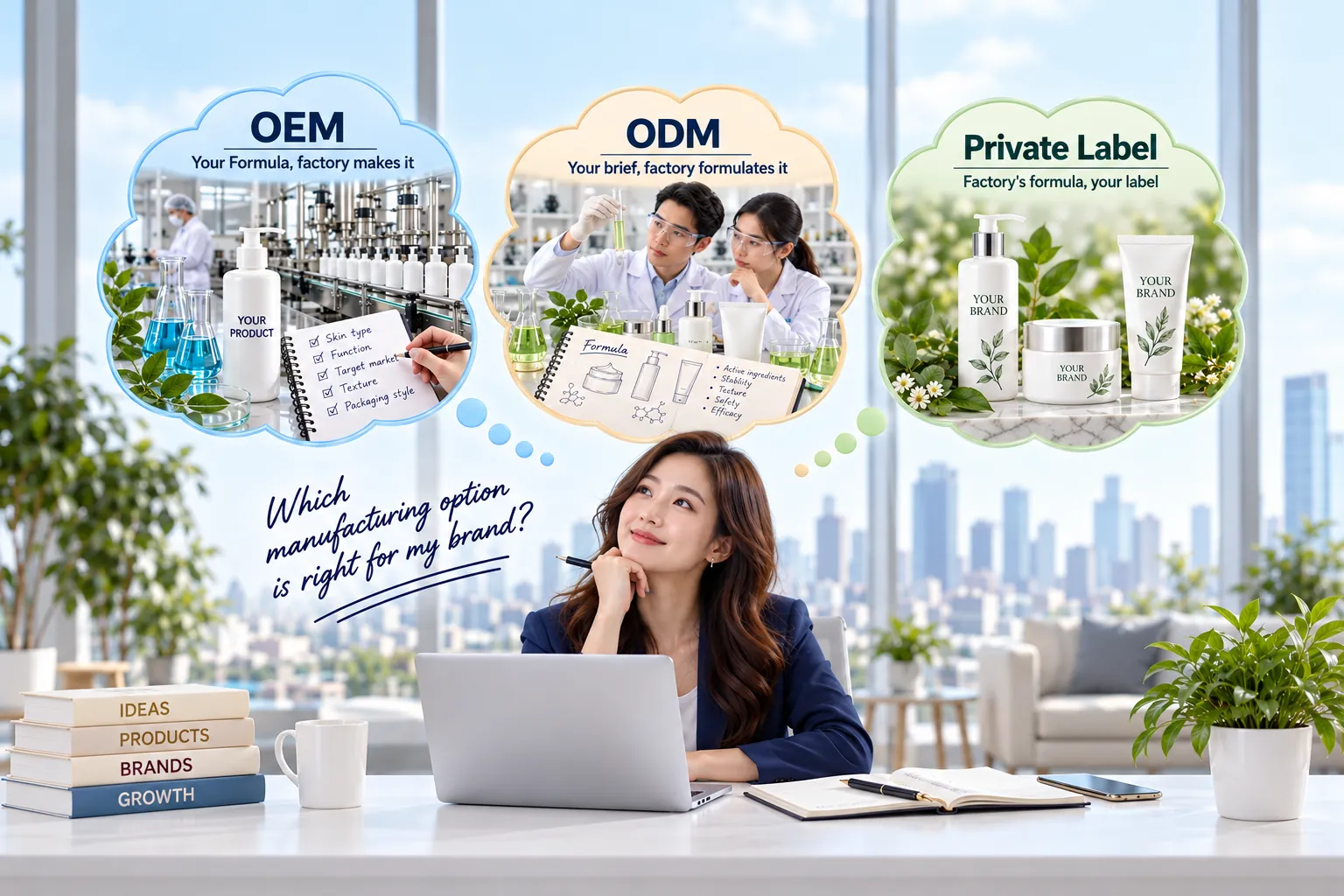
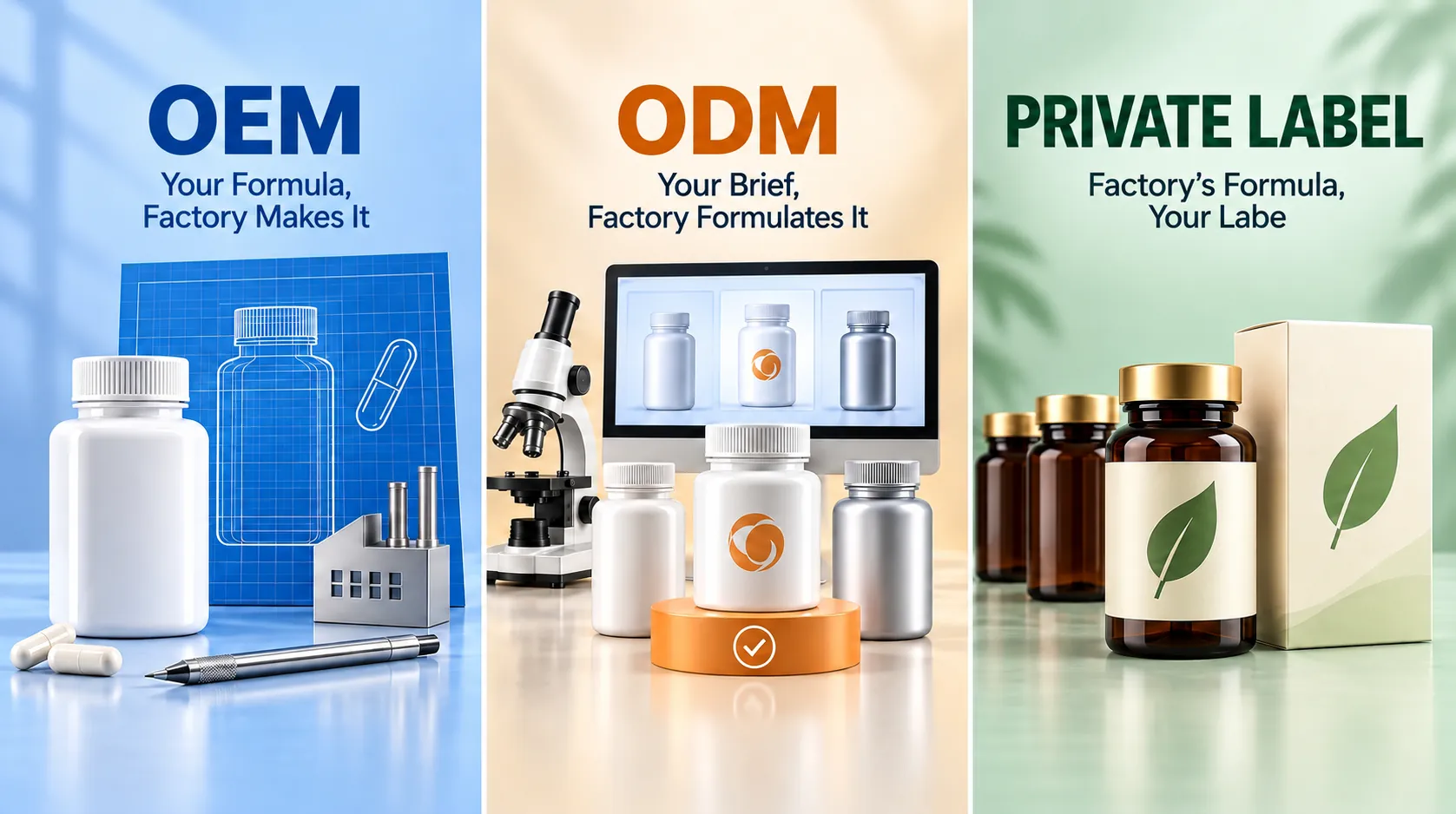
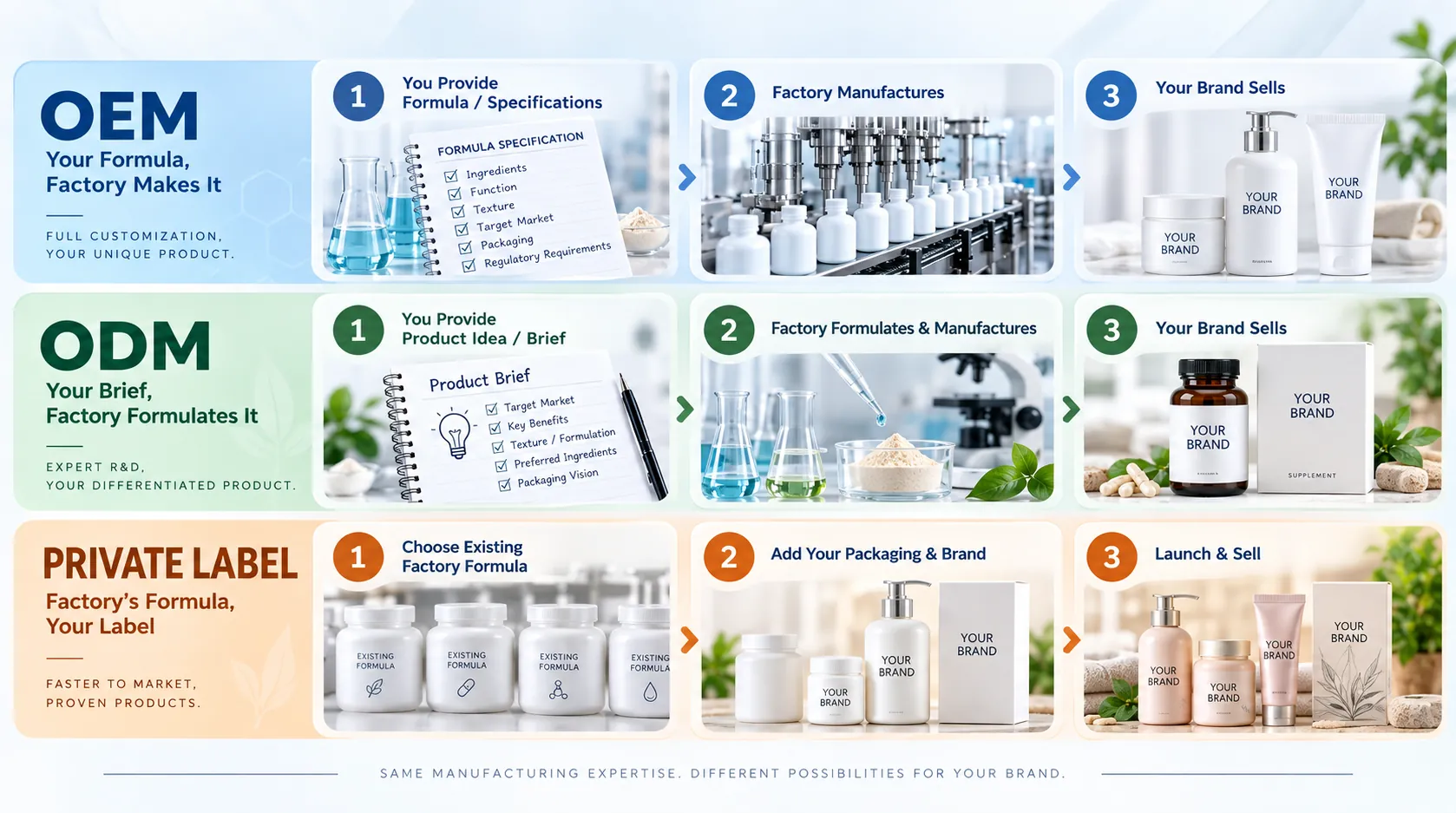
OEM usually starts with your formula or product brief. ODM starts with a formula the manufacturer has already developed, which you adapt for your brand. Private label uses an existing product with little or no formula change. The choice depends on how much development you need, your launch budget and the control you want over the finished product.
For a brand owner, these differences affect more than the first order. Before choosing a route, you need to know who owns the formula, what testing is included and who handles the regulatory work. An existing formula can reduce development work, but it does not automatically give your brand permission to sell the product in every market.
This guide is for businesses launching a first product, expanding an established range or looking for a more dependable manufacturer. It focuses on supplements, skincare and personal care, with guidance for food, beverages and home care too.
Under OEM, short for Original Equipment Manufacturer, the factory makes a product to your specification and sells it to you under your brand.
You do not have to arrive with a finished formula. You can start with a brief: who the product is for, what it should do and your target cost. The manufacturer’s laboratory then develops the formula, prepares samples for review and carries out the agreed testing, including stability testing.
OEM is worth considering when a specific formulation is central to your product. Before paying for development, agree what you will own and which documents you will receive. Having a formula developed for you and owning the rights to it are separate matters.
With ODM, short for Original Design Manufacturer, you start with a formula the factory has already developed and adapt it for your brand.
Changes may include fragrance, colour, active concentration within an agreed range, or packaging. Ask which changes are possible and what testing they require. The manufacturer usually retains the base formula, so any right to use it elsewhere needs to be agreed in writing.
ODM can suit a retailer adding to its range, a distributor with an established sales network or a founder with a clear audience. If an existing formula meets your customers’ needs, it may make sense to build on it. Use the sample review to decide whether it is good enough for your brand before requesting custom development.
Private label means selling an existing product under your own brand, usually with a choice of labels or packaging and little scope to change the formula. It overlaps with ODM, and suppliers use the terms differently. Ask to see the product and confirm exactly what you can change.
It is often the quickest route because less development is needed. The trade-off is limited exclusivity: other brands may use the same base product. Check what regulatory work remains for your brand and target market even if the supplier says the product is already registered.
Contract manufacturing is a broader term that can cover OEM and ODM work. OBM means Original Brand Manufacturer: a factory selling products under its own brand. When discussing a quotation, ask the supplier to describe the work and rights included rather than relying on the abbreviation.
| OEM | ODM | Private label | |
|---|---|---|---|
| Who owns the formula? | As agreed in the contract | Usually the manufacturer | Usually the manufacturer |
| Development cost | Usually higher for a new formula | Usually lower | Usually lowest |
| Speed to market | More time if development is needed | Less development, depending on changes | Often quickest, subject to launch requirements |
| Exclusivity | Must be agreed | Must be agreed | Usually none |
| Can you move production later? | Depends on rights, records and transfer requirements | Only with agreed rights or a new formula | Only with agreed rights or a new product |
| Registration or notification | Confirm requirements for the product and market | Confirm requirements for the product and market | Check whether existing coverage applies |
| Best suited to | Brands needing a specific formulation | Brands whose advantage is distribution or audience | Market testing and fast launches |
ODM and private label usually need less spending on development because the base product already exists. That can be useful for a first launch, when you are still testing demand. Ask the supplier to separate development and testing fees from production and packaging costs so you can see what you are paying for.
Before comparing unit prices, ask what you will pay for the first order, what repeat orders will cost and what rights are included.
Owning a formula can give you more options when negotiating production, extending the range or selling the business. Those options depend on your agreement and access to the technical records. They do not guarantee that OEM will become cheaper than ODM.
Compare quotations against the same product brief, packaging and expected volumes. Include the minimum order quantity and the amount of stock you would need to commit to. A vitamin C chewable and a sunscreen need different development work, so there is no useful universal break-even figure. A three-year comparison can help, provided the sales assumptions are realistic.
Ask about ownership while the development proposal is being prepared. This is especially useful if you are replacing a manufacturer because of inconsistent quality, capacity limits or delivery problems. Before asking another factory to make the same product, establish which formula rights and records you can take with you.
Stability data supports the shelf life you put on the product. Ask whether you can use it after a manufacturing change and what further testing would be needed. Also distinguish the product owner from the company handling the regulatory submission. Agree who can access records and manage changes, especially if you plan to export.
The product format helps determine how much development and testing you need. A formula that looks suitable on paper still needs to work in the finished tablet, sachet or bottle. Discuss the points below when reviewing a sample and its quotation.
| What needs attention | |
|---|---|
| Powder drink | Blend uniformity, moisture control, taste masking, sachet fill accuracy |
| Tablet, coated and uncoated | Compression behaviour, coating adhesion, disintegration time |
| Chewable tablet | Compression, disintegration and taste; coating where used |
| Capsule | Fill consistency, shell compatibility, and whether the shell is vegetable and Halal certified |
| Cream and paste | Emulsion stability, preservative system, pH, separation across shelf life |
| Liquid | Preservation, clarity, packaging compatibility, fill line behaviour |
| Toothpaste | Abrasive selection, fluoride or fluoride-free system, tube compatibility |
We manufacture across all of these, including powder drinks, coated and uncoated tablets, chewables, Halal certified vegetable capsules filled with liquid or powder, creams, lotions, liquids, scrubs, oils, and toothpastes.
A face mist and a sunscreen call for different testing discussions, even though both are skincare products. Explain the format and the claims you want to make before asking whether OEM or ODM is a better fit. Ask the manufacturer to show which parts of the brief an existing formula meets and which would require development.
Yes. Check whether the manufacturer can support your product category and intended market before comparing prices, especially if you plan to export.
In Malaysia, health supplements require registration with the National Pharmaceutical Regulatory Agency (NPRA) and receive a MAL number. Cosmetics are notified and receive a NOT number. Cosmetic notification is not product approval: the responsible company must still meet safety, quality and other requirements. The applicable regulatory process needs to be completed before the product enters the market.
OEM, ODM and private label describe manufacturing arrangements, not regulatory clearance. If a supplier offers an existing product, ask which registration or notification applies, who holds it and whether your proposed brand or product changes require a new submission. Settle these questions before committing to a launch date.
Our plant holds GMP from the Malaysian Ministry of Health, ISO 22000:2018, HACCP MS 1480, MeSTI, Halal certification from JAKIM, and US FDA registration. Ask us which certificates and supporting documents apply to your product category and destination market.
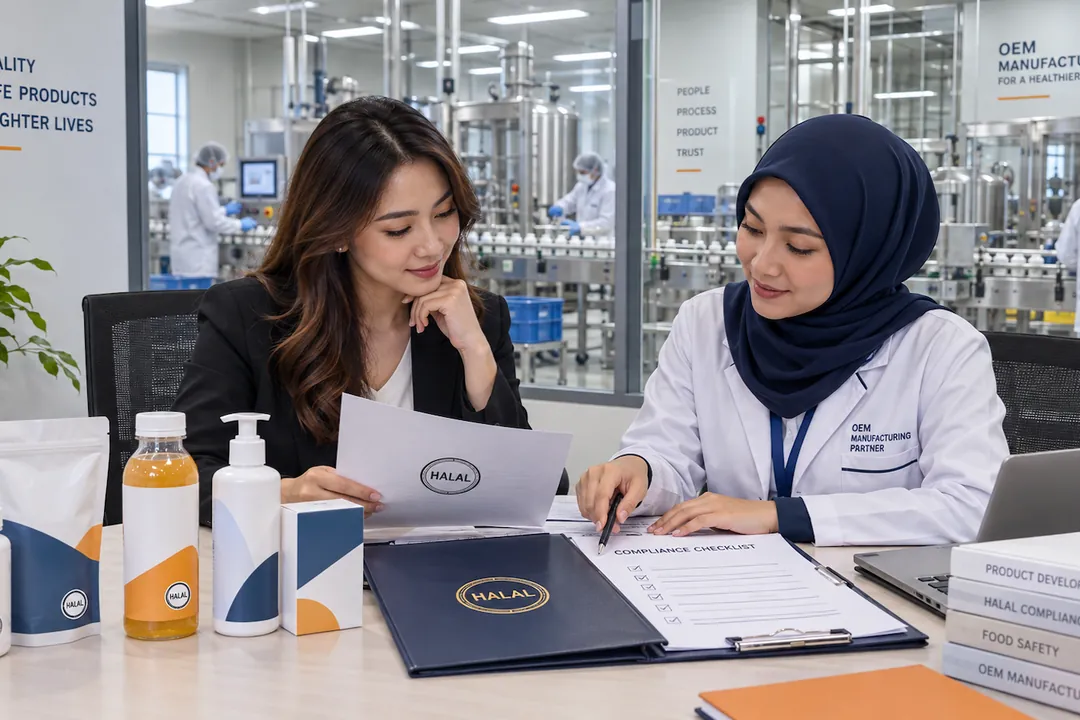
Confirm the arrangement for your brand before printing the Halal Malaysia logo. A factory’s existing certification is not enough to assume that your new product is covered.
Brand owners can apply for certification in their own company’s name when the manufacturer holds the appropriate OEM certification. Confirm the applicant, the relevant product scheme and the products covered with JAKIM or the responsible state authority. Include responsibility for the application and supporting documents in your manufacturing agreement.
Working with a certified manufacturer gives you an established facility and Halal controls to work with. You still need to check the scope and validity of the certificates relevant to your project, including any renewal requirements.
Allow for certification work in your launch budget and schedule, alongside formulation, packaging and production.
Requirements vary by product category and destination. Check the current requirements with JAKIM and NPRA, or ask us to review what your product will need before you set a launch date.
The same choice applies: develop to a brief, adapt an existing formula or use a finished product. The technical work depends on what you are making.
For beverages and premix powders, discuss taste, solubility and shelf stability. Food safety systems such as ISO 22000, HACCP MS 1480 and MeSTI are relevant to food manufacturing. Confirm the product’s classification and applicable requirements before treating it as a food or a health supplement.
For home care, ask about the surfactant system, viscosity and fragrance stability, as well as compatibility with the bottle or other packaging. Review the formula and packaging together, particularly where the product could degrade certain plastics over time.
For both categories, put formula ownership and permitted use in writing. Paying for development should come with a clear agreement about what that payment buys.
Our first factory opened in 1989. Today, our plant covers 4.4 acres with 252,000 square feet of built-up area, and we export to more than 29 countries. We manufacture food and beverage, health supplements, traditional products, personal care, and home care products.
We start with your brief and prepare a proposal, then a sample batch for you to review before confirming the order. Our laboratories handle formulation and testing. Production includes quality assurance, with the applicable registration work coordinated as part of the project. Shipment follows final QA approval.
We also support packaging, registration paperwork and Halal documentation. If you are launching, expanding a range or changing manufacturers, request a quotation with your product idea, target market, preferred format and expected order volume. Tell us what needs to improve if you already have a product. You can also browse Key Insights & Resources for more manufacturing guides.
Support
Answers to help you prepare a product brief and understand what to confirm before placing an order.
We support formulation and testing, sample development, packaging, production and quality assurance, with product registration support and Halal documentation. Our OEM and ODM services cover health supplements, food and beverages, traditional products, personal care and home care. If you want a private label product, tell us the category and changes you need so we can confirm the available options.
MOQ depends on the format, packaging and whether we are using an existing formula or developing a new one. Send your preferred pack size and expected first-order volume with your brief so we can confirm the MOQ in the proposal. Compare the total stock commitment as well as the unit price. Our MOQ guide explains what to check before a first order.
Yes. You can bring a finished formula or start with a product idea. Tell us who it is for, the format, intended market and target cost; our laboratory can develop samples against that brief. Before development starts, confirm the testing scope, formula ownership and documents included in the proposal.
Yes. Our plant holds GMP, ISO 22000:2018, HACCP MS 1480, MeSTI and JAKIM Halal certification, and has US FDA registration. Confirm which certification scope applies to your product. If you intend to use the Halal Malaysia logo, we can discuss the product application and documentation needed for your brand.
We manufacture food and beverages, health supplements, traditional products, personal care and home care, with exports to more than 29 countries. We work with new and established brands, distributors, retailers and direct-selling businesses. Include your intended sales market when enquiring so the discussion covers the product and documentation you need.
Let’s build your next product
From formulation to manufacturing and scale-up,
our team is ready to help bring your product to market.
Compliance
Find out whether your brand needs JAKIM halal certification with a certified manufacturer, & what to verify before printing your packaging.
Budgeting
Learn how order quantity affects unit cost, packaging & inventory risk, & choose a production volume that fits your budget.
OEM & ODM • Packaging • Production
Choose an OEM manufacturer by checking product fit, compliance, quality & costs for a confident launch & reliable supply.
Compliance
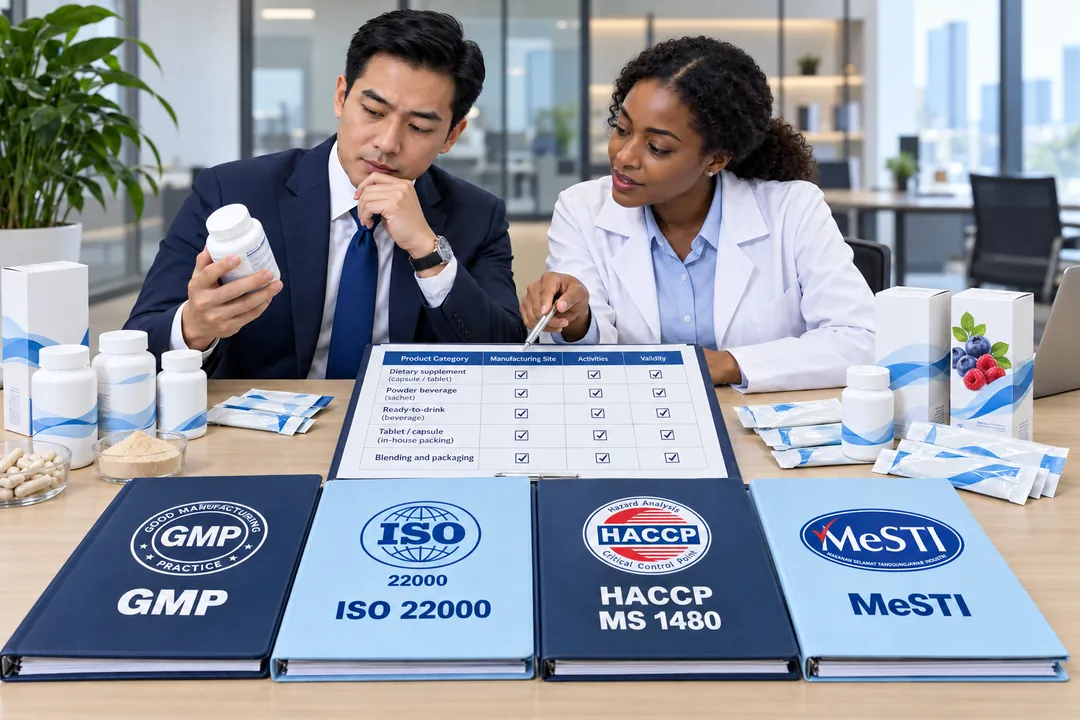
Learn what GMP, ISO 22000, HACCP MS 1480 & MeSTI cover, and how to assess a manufacturer's certifications before choosing an OEM partner.
Packaging • Food & Beverage • Supplement
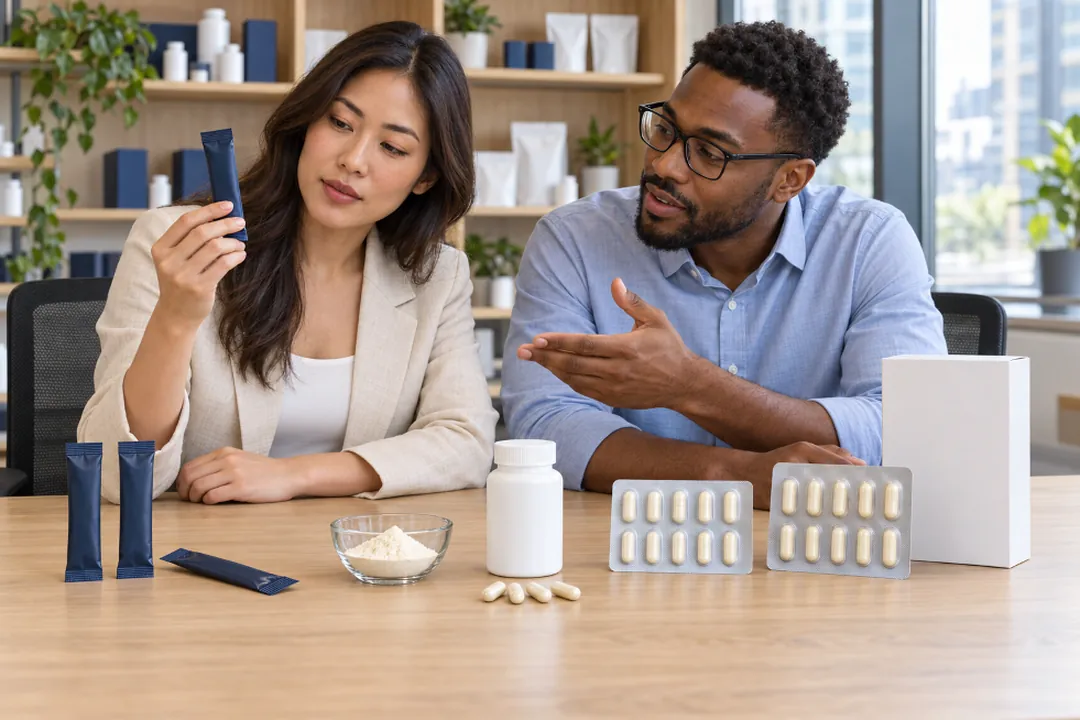
Compare sachets, bottles & blister packs to choose packaging that suits your supplement, protects quality & offers convenience.
Food & Beverage
Explore the key steps in powdered beverage development, from defining your product brief to formulation, sample approval and production.
Home Care
Learn how to define your detergent formula, choose packaging & work with an OEM manufacturer to launch your brand.

Packaging • Food & Beverage
Learn what to check on food labels in Malaysia before printing packaging to avoid costly mistakes & delays.

Are you sure you want to
delete this 1 Item?